RoPE: How LLMs Encode Position and Extend Context
How rotary position embeddings encode token order by rotating query and key vectors, and how position interpolation and YaRN stretch a model's context window.

At some point while running LLM agents you hit an error that reads maximum context length exceeded. You go looking for a bigger window and find a config knob named rope_scaling, or a suggestion to “just raise rope_theta.” It works, sort of: the model starts accepting longer inputs. But it also gets subtly worse at the lengths it used to handle well, and nobody in the thread quite explains why.
The explanation lies in how the model encodes position in the first place. This is one piece of the stack that is genuinely worth understanding instead of pattern-matching around.
This post is for engineers who use transformer models day to day: building agents, feeding long documents to a RAG system, or stuffing a growing transcript back into a prompt. It explains what rotary position embeddings (RoPE) actually do, why running past the trained length breaks so hard, and what the context-extension tricks really trade away. The only math you need is a 2D rotation.
Why attention needs position information
Self-attention has a property that is easy to forget: on its own, it ignores order. It computes how much each token should attend to every other token using only their vectors. Shuffle the tokens and you get the same set of vectors back, just in a different arrangement. Without position injected somewhere, “dog bites man” and “man bites dog” would look identical to the attention mechanism. The model has to be told where each token sits.
Earlier models did this in one of two ways:
- The original Transformer added a fixed sinusoidal vector to each token embedding at the input.
- GPT-style models learned an absolute position vector for each slot.
Both share a weakness. The position signal is bolted on once, at the bottom of the network, as an absolute address. A learned position embedding for slot 5000 simply does not exist if you only ever trained up to 4096. And a model that has only seen absolute positions 0 through 4095 has no sensible behaviour for 4096.
What RoPE does: rotate instead of add
RoPE, introduced in the RoFormer paper (Su et al., 2021), takes a different route. Instead of adding a position vector, it rotates the query and key vectors by an angle proportional to their position. It does this inside every attention layer, not once at the input.
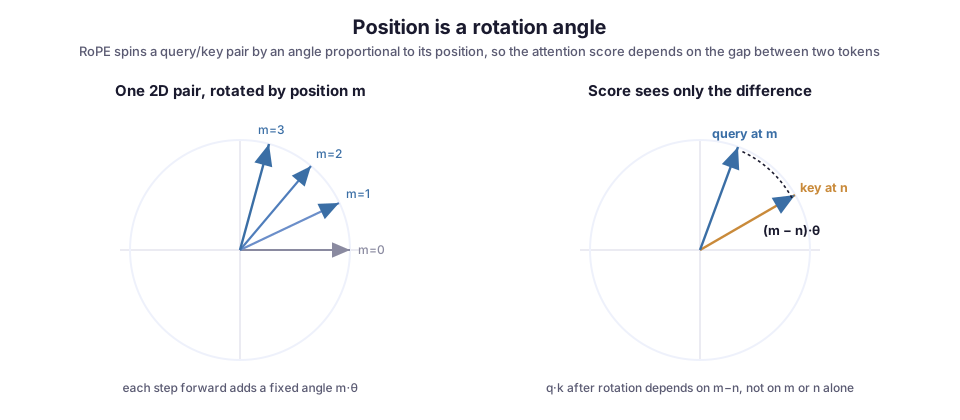
Here is the mechanism. Split a query or key vector into pairs of dimensions, and treat each pair as a point in a 2D plane. For a token at position m, RoPE rotates that pair by the angle m·θ. Position 0 is unrotated, position 1 is rotated by θ, position 2 by 2θ, and so on. The further along the sequence a token is, the more its vector has spun.
Why rotation gives you relative position
This is the clever part. Attention compares a query at position m with a key at position n by taking their dot product. After rotation, the two angles combine so that the result depends on the difference m − n, not on m and n separately. Absolute rotations go in; relative position falls out.
The RoFormer abstract highlights this property. It credits RoPE with three things:
- relative position encoding,
- a natural decay of attention as tokens get further apart,
- no hard dependence on a fixed sequence length.
The EleutherAI writeup is the clearest intuition-level explanation if you want the geometry spelled out.
Many frequencies, like clock hands
One vector has many dimension pairs, and RoPE gives each pair its own rotation speed, or frequency. Pair i uses θ_i = base^(−2i/d), where d is the head dimension and base is a constant, 10000 in the original formulation.
- Low-index pairs spin fast and encode fine, local position.
- High-index pairs spin slowly and encode coarse, long-range position.
Think of a set of clock hands running at different speeds: together they pin down where a token is across scales.
In code the rotation is cheap, just a couple of element-wise multiplies. Here it is applied to the queries and keys, with the sines and cosines for each position computed ahead of time:
# q, k: (..., seq_len, head_dim); cos, sin precomputed per position
def rotate_half(x):
    x1, x2 = x.chunk(2, dim=-1)
    return torch.cat((-x2, x1), dim=-1)

def apply_rope(q, k, cos, sin):
    q_rot = q * cos + rotate_half(q) * sin
    k_rot = k * cos + rotate_half(k) * sin
    return q_rot, k_rot
Notice what is missing: no extra parameters, and no lookup table that runs out at some length. That is exactly why most current open-weight models use RoPE, and exactly why context extension is even on the table.
Why going past the context limit breaks so hard
Because position is an angle, a position the model never saw during training is an angle it never saw. Feed a model trained to 4k a sequence of 8k tokens, and the later positions rotate the vectors into a region of the circle that never showed up in training.
The dot products the attention layer produces there are not slightly off. The position interpolation paper (Chen et al., Meta, 2023) found that raw extrapolation can produce attention scores large enough to wreck the mechanism outright. That is why quality falls off a cliff instead of degrading gracefully when you exceed the window: you have pushed the geometry somewhere it was never fit.
Extending the window: interpolate, don’t extrapolate
If unseen angles are the problem, the fix is to keep every position inside the angles the model has already seen. The methods below differ in how they do that.
Position Interpolation: shrink every position
The fix Chen et al. proposed is almost embarrassingly direct. Instead of letting positions run off the end, scale them down so the new maximum lands inside the trained range. Want 8k on a 4k model? Multiply every position index by 4096/8192 = 0.5 before computing the rotation. Position 8000 is now presented as 4000, an angle the model has seen, and everything stays in distribution.
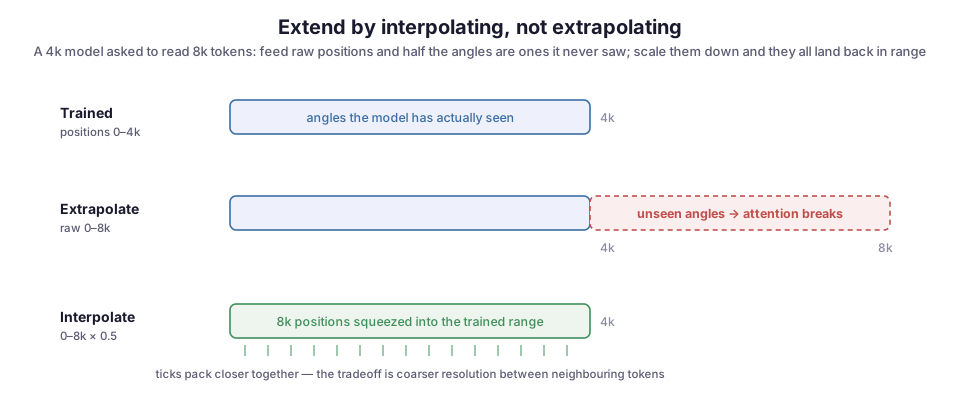
That is Position Interpolation. It extended LLaMA models to 32768 tokens with only light fine-tuning (on the order of a thousand steps), because it reuses angles the model already understands instead of teaching it new ones. The theoretical bound the paper derives is roughly 600× tighter for interpolation than for extrapolation, which matches what everyone saw in practice.
NTK-aware scaling and YaRN: stretch each frequency differently
The obvious refinement is that stretching every dimension by the same factor is wasteful. The fast-spinning pairs that encode local position do not need much stretching, while the slow ones carry the long-range signal.
The community’s NTK-aware trick (NTK is short for neural tangent kernel, the theory that motivated it) often surfaces as advice to “raise rope_theta”, which is the base from the formula above. It changes the base frequency instead of the positions, and that stretches the low-frequency dimensions more than the high-frequency ones.
YaRN (Peng et al., 2023) formalized this. It:
- blends linear and NTK-style interpolation, with a ramp across dimensions,
- adds a temperature term to keep the attention distribution stable at long inputs,
- reports reaching the same quality with about 10× fewer tokens and 2.5× fewer training steps than plain interpolation.
When a Hugging Face config has "rope_scaling": {"type": "yarn", ...}, this is the machinery behind it. EleutherAI’s follow-up post on YaRN walks through the derivation if you want it.
Tradeoffs and failure modes
The context-extension knob is real, but it is not free, and the failure modes are where the time goes.
Interpolation trades away resolution. Squeezing 8k positions into the angular range built for 4k puts neighbouring tokens closer together in rotation space than they used to be. The model’s ability to distinguish “token 12 versus token 13” gets coarser. That is the tick marks packing together in the diagram. It is also why a naively interpolated model often gets a little worse on short inputs, the exact lengths it was already good at. If you extend, evaluate at both the new length and the old one.
“Free” extension without fine-tuning usually disappoints. You can set the scaling flag and skip training. The model will accept the longer input, but eval numbers for material in the middle of a long context tend to sag. Long-context models are known to use the beginning and end of the window more reliably than the middle, and stretching the positions without any adaptation makes that worse. The config change gets you a bigger buffer, not a model that reasons well across all of it.
The real cost is the KV cache, which grows with the window. The rotation itself is a rounding error in the compute budget. Memory is not. Every extra token you can now fit is another token whose keys and values sit in the KV cache, which grows linearly with sequence length. Quadrupling the context roughly quadruples the cache footprint per request, and that footprint is what actually decides how many concurrent requests fit on a GPU.
So the cheap-looking flag moves the bottleneck to memory. The context gets bigger, the number of requests that fit on a card gets smaller, and the ceiling you hit under load is VRAM, not anything about position. It is worth pairing this with how FlashAttention keeps the attention step itself from blowing up on long sequences.
Extension is not the same as training on long documents. Interpolation makes long positions legible. It does not teach the model skills that only appear in genuinely long training data. Treat it as a way to avoid catastrophic breakage past the limit, not as a substitute for a model actually trained at the length you need.
What I reach for
A growing agent transcript is the failure mode behind half the context-window headaches I run into while building tools like LLM DevMate. When it happens, there are two honest moves:
- Extend the window, and pay for it in KV-cache memory and some resolution.
- Keep the window fixed, and manage what goes into it with summarization, retrieval, and pruning.
RoPE is why that is a real choice instead of a free lunch. Position is a rotation, extrapolation lands on angles the model has never seen, and every trick for getting past that buys legibility at the far end of the sequence with something you give up elsewhere. Knowing which knob you are turning, and what it costs, is most of the battle.
Diagrams by M. Hassan Ahmed, released under CC0. No external image was used for this post; the figures are original work by the author.